Skip to content

Blog · Cloud Computing

AWS vs GCP vs Azure: How to Actually Choose a Cloud in 2026

The three big clouds are more alike than any of them would like you to believe, and the differences that matter have little to do with feature checklists. Here's what actually separates them, what genuinely doesn't, and a decision framework built on the factors that will still matter in five years.

VaultFifty1 Team·August 25, 2026·10 min read
AWS vs GCP vs Azure: How to Actually Choose a Cloud in 2026

Ask three engineers which cloud to pick and you'll get four opinions, most of them formed years ago and defended ever since. The comparison articles don't help much either: endless feature matrices comparing 200 services per provider, as if anyone chooses a cloud because one of them has a slightly better managed blockchain.

Here's the honest starting point: for the workloads most businesses actually run, virtual machines, containers, object storage, managed Postgres, queues, load balancers, all three major clouds are excellent. They are more alike than any of their marketing departments would like you to believe. Which means the decision doesn't come down to the checklists. It comes down to a handful of structural factors, and those are worth getting right, because this is one of the stickiest decisions your company will make.

What genuinely doesn't differentiate them anymore

Save yourself weeks of analysis by crossing these off first:

  • Core reliability. All three run world-class infrastructure with comparable SLAs and comparable real-world uptime. Each has had famous outages; none of them is "the unreliable one".

  • Core service quality. Compute, block and object storage, managed relational databases, Kubernetes, queues, CDNs: mature, capable and roughly equivalent on all three.

  • Headline pricing. On comparable resources, list prices sit within roughly ten to twenty percent of each other, and committed-use discounts compress the gap further. Your cost discipline will move the bill far more than your provider choice.

  • Security capability. All three give you the primitives to build a very secure system, and all three make it possible to configure a very insecure one. The variable is your team's practices, not the platform.
  • If a vendor comparison is leaning hard on any of those, it's selling, not informing.

    Where they actually differ

    AWS: the deep catalog and the deep bench

    AWS is still the biggest cloud by share, and its practical advantages follow from that: the broadest service catalog, the most mature third-party ecosystem, and, importantly for you, the largest hiring pool of engineers who already know it. Almost every SaaS tool integrates with AWS first. Almost every problem you'll hit has already been hit, documented and answered by someone else.

    The cost of that breadth is coherence. Two hundred plus services accumulated over two decades means overlapping options, uneven ergonomics and IAM policies that have made grown engineers cry. AWS rewards teams who invest in platform expertise; it punishes casual use with complexity and surprise bills.

    Azure: the enterprise gravity well

    Azure's decisive advantage is not a service, it's a relationship. If your organization already runs on Microsoft 365, Active Directory and enterprise agreements, Azure arrives with identity integration your security team already understands, license mobility that makes Windows and SQL Server workloads meaningfully cheaper, and procurement that folds into the agreement you already negotiate. For a Microsoft-centric enterprise, choosing Azure is often less a migration than an extension.

    Its hybrid story (Azure Arc, on-prem integration) is the strongest of the three, which matters for organizations that will realistically never be 100 percent cloud. Outside the Microsoft gravity well, Azure is competitive but rarely the standout, and its developer experience still trails the other two in consistency.

    GCP: the engineer's cloud

    GCP is the smallest of the three, and the one engineers most often prefer on pure ergonomics. Kubernetes was born at Google and GKE remains the best managed Kubernetes on the market. BigQuery is arguably the best data warehouse anywhere, and the analytics and ML tooling around it is first-class. Networking, sustained-use discounts that apply automatically, and a generally cleaner console round out a platform that feels designed rather than accumulated.

    The trade-offs are ecosystem-sized: a smaller service catalog, a smaller talent pool, fewer third-party integrations, and an enterprise sales and support motion that still lags the other two. GCP is a superb choice for product and data teams; it asks more faith from procurement departments.

    AWSAzureGCP
    Strongest whenYou want breadth, ecosystem and hiring easeYou're already a Microsoft organizationKubernetes, data and analytics lead your stack
    Service catalogBroadest, some overlapBroad, enterprise-focusedFocused, opinionated
    Talent poolLargest by farLarge, enterprise-heavySmallest of the three
    Developer experiencePowerful, unevenImproving, inconsistentCleanest of the three
    Managed KubernetesEKS, solidAKS, solidGKE, best in class
    Data & analyticsMature, many optionsStrong, Fabric-centricBigQuery, best in class
    Hybrid / on-premOutpostsStrongest (Arc)Anthos
    Watch out forComplexity, IAM sprawlWeakest fit outside Microsoft shopsEcosystem and support depth

    The factors that should actually decide it

    In rough priority order:

  • 1. What your team already knows. An 80 percent fit your engineers can operate confidently beats a 95 percent fit they'd be learning during incidents. Re-skilling a team costs real months; that cost belongs in the comparison.

  • 2. Where your identity and licensing already live. Existing Microsoft agreements pull hard toward Azure. Heavy Google Workspace and data-team gravity pulls toward GCP. No gravity means AWS's ecosystem is the safe default.

  • 3. The one or two services your product genuinely depends on. If BigQuery, or a specific AWS service, or Azure OpenAI is central to your roadmap, weight that heavily and ignore the other 195 services in the matrix.

  • 4. Compliance and regions. Data-residency requirements and specific certifications occasionally decide this outright. Check early; it's cheaper than discovering it late.

  • 5. Credits and discounts, last. Take them, negotiate them, and never let them choose your architecture. Credits expire in a year; the platform decision outlives them by a decade.
  • Lock-in: manage it, don't fear it

    Every cloud rewards you for going deeper with it, and the pull is real: proprietary services are often genuinely better than the portable alternative. The mistake isn't using them, it's using them by accident.

  • Keep the portable layer portable. Containers over proprietary runtimes where it's cheap to do so, Postgres and MySQL over proprietary databases by default, Terraform over provider-only provisioning.

  • Spend lock-in deliberately. Adopting BigQuery or DynamoDB because it clearly wins for your workload is a good trade. Reaching for the proprietary option by reflex, everywhere, is how exits become impossible.

  • Respect egress. Moving data out is where all three charge most. Data-heavy architectures should think about egress at design time, not at renegotiation time.
  • And on multi-cloud: as a resilience strategy for one system, it's usually a tax without a benefit. You inherit two security models, two networking stacks and a split team, while most real-world outages are regional anyway. The honest version of multi-cloud is different workloads on their best-fit clouds, with clean boundaries between them.

    Choosing a cloud, or wondering if the one you're on is quietly overcharging you? Our DevOps and cloud services cover platform selection, migration and cost optimization, and a System Review will audit what your current setup really costs against what it should.

    The bottom line

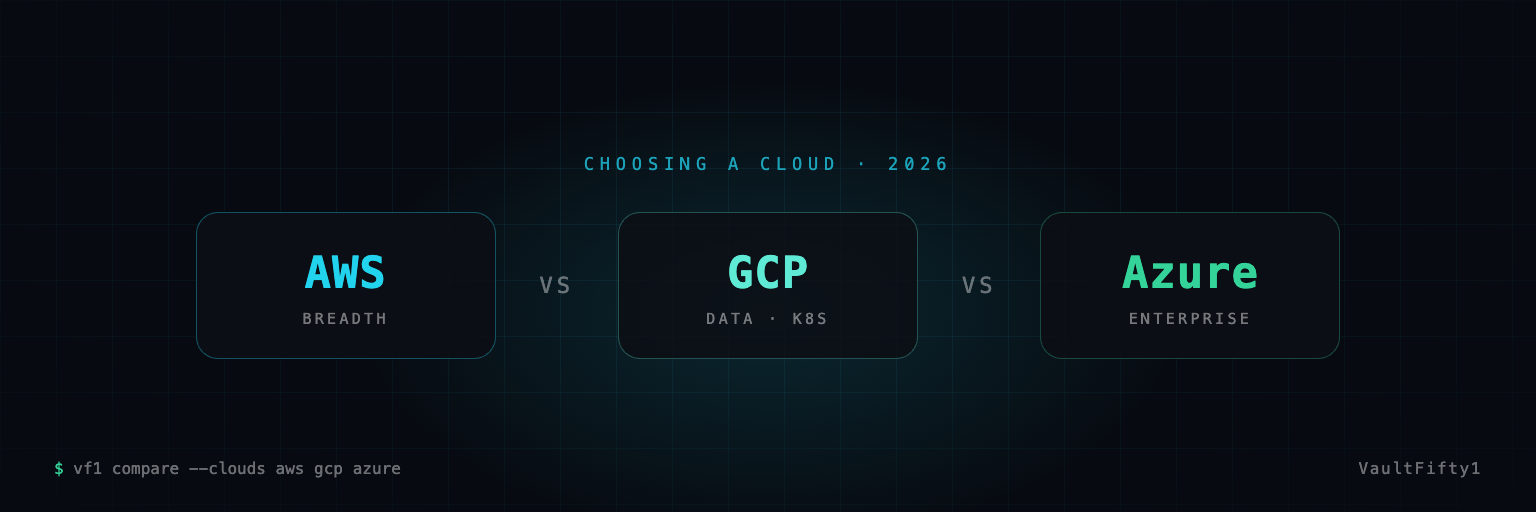
    Stop comparing feature matrices; at the level that matters, the three clouds are peers. Choose on fit: Azure when you're already a Microsoft organization, GCP when Kubernetes and data are the heart of your product, AWS when you want the deepest ecosystem and the easiest hiring, or when nothing else pulls harder. Whichever you pick, go deep instead of hedging across two, keep your portable layers portable, and put your energy where the real money is: running the platform well. A well-operated deployment on any of the three beats a neglected one on the "perfect" cloud every single time.

    Cloud ComputingAWSGCPAzureCloud StrategyInfrastructure

    FAQ

    Frequently asked questions

    On comparable compute and storage, list prices land within roughly ten to twenty percent of each other, and discounts (reserved instances, savings plans, committed use) narrow the gap further. GCP often prices slightly below AWS on compute and includes sustained-use discounts automatically. But in practice, cost is dominated by how well you run the platform: right-sizing, storage tiers and egress design routinely swing bills by more than the difference between providers.

    Default to the platform your founding engineers already know, because operating confidence beats marginal feature advantages. If nobody has a strong background in any of them, AWS offers the largest talent pool, the most tutorials and the most third-party integrations, which keeps hiring and unblocking easy. Take the startup credits from every provider, but do not architect around them: credits expire, architecture stays.

    Azure is a capable general-purpose cloud, but its decisive advantages are Microsoft-specific: Azure AD/Entra integration, existing enterprise agreements and license mobility for Windows Server and SQL Server can make it dramatically cheaper and simpler for organizations already inside that ecosystem. Outside it, Azure is competitive but rarely the standout, and the case usually comes down to compliance or regional needs.

    Lock-in is the switching cost you accumulate by depending on things that only exist on one provider: proprietary managed services, provider-specific IAM models and data that is expensive to move because of egress fees. You limit it by keeping the portable layer portable, containers, open-source databases, Terraform, and by adopting proprietary services deliberately where they clearly pay for their lock-in, rather than by reflex.

    Usually not by choice, at least not at the start. Running two clouds means two security models, two networking stacks, double the operational tooling and a team split across both, while the resilience benefit is smaller than it sounds because most real outages are regional, not provider-wide. Multi-cloud makes sense when acquisitions, data-residency rules or a specific best-of-breed service force it, and even then it works best as separate workloads on their best-fit cloud rather than one system stretched across two.